
This piece originally ran in the November 2025 issue of EAA Sport Aviation magazine.
The release of the final Modernization of Special Airworthiness Certification (MOSAIC) rule in July at EAA AirVenture Oshkosh 2025 built heavily on the legacy of the original 2004 light-sport aircraft and sport pilot rules. These original rules opened up new opportunities for light aviation with two-seat aircraft that could be flown free of training exemptions, but the loss of those exemptions also left holes in the ultralight training system that have been difficult to fill.
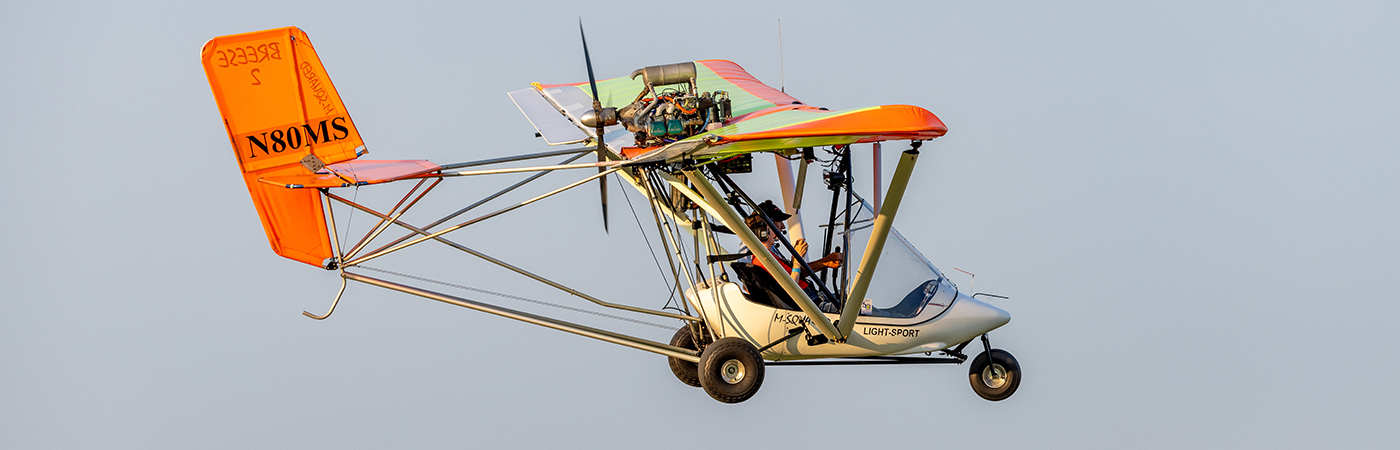
EAA has been working to make ultralight training in “low mass, high drag” aircraft more widely available, and we earned a significant win last year with the implementation of a new flight training rule. This rule expands the use of experimental aircraft for flight training under a letter of deviation authority (LODA) from the FAA, allowing experimental aircraft to fill more underserved training niches like ultralight and specialty sport pilot instruction.
The road to becoming a flight instructor and offering training still contains challenges, but the LODA makes it easier than ever to provide instruction for hire in a wide range of lightweight and unique aircraft.
The Instructor
To provide instruction in sport pilot eligible aircraft (either for a sport pilot student or a prospective ultralight pilot), you will need at least a certificated flight instructor with a sport pilot rating (CFI-SP). The qualifications for and privileges of this certificate are listed in 14 Code of Federal Regulations 61 Subpart K.
In brief, you will need:
- At least a sport pilot certificate with category/class ratings or operating privileges matching the CFI-SP privileges sought.
- One hundred fifty total hours for fixed-wing and weight-shift control aircraft, 125 hours for rotorcraft, or 100 hours for powered parachutes. These time requirements are further broken down into pilot in command, category/class, cross-country time, and more. See 14 CFR 61.411 for more information.
- Pass the Fundamentals of Instructing (FOI) knowledge (written) test (waived for certificated ground instructors, licensed teachers, and college professors).
- Pass the CFI-SP knowledge test (written).
- Pass the CFI-SP practical test (checkride).
This certificate does not require the normal prerequisites of the traditional CFI certificate, including an instrument rating and a commercial pilot certificate. As a CFI-SP, you will be able to train sport pilot candidates as well as those seeking to operate an ultralight vehicle.
The difficulty of becoming a CFI-SP will vary based on your background in aviation. An experienced sport or private pilot should be able to meet the requirements without much trouble. An experienced ultralight pilot will first have to receive a sport pilot certificate and accumulate time in an applicable aircraft as pilot in command.
The CFI-SP certificate is actually similar in qualification to ultralight flight instructors (UFIs) under EAA’s previous exemption. UFI candidates needed 100 hours’ ultralight time (or 20 hours if already certificated as a private pilot), then required a training curriculum, passing the FOI knowledge exam, and a practical test. The primary difference today is the prerequisite of at least a sport pilot certificate and the fact that the CFI-SP candidate is working with the FAA rather than EAA as an exemption holder. However, the CFI-SP certificate comes with the expanded privilege of being able to train sport pilot candidates.
EAA is always looking for ways to make training more accessible. In recent years, we have explored pathways to make requirements less burdensome for ultralight pilots to be able to train other ultralight pilots. This work continues. If you see barriers to obtaining instructor privileges, please contact us.
The Aircraft
The original (2004) light-sport rule was intended to create a new class of aircraft, built in factories to industry consensus standards, that could replace the training ultralights of the exemption era. These were aircraft built under the special light-sport aircraft (S-LSA) rule.
The previously exempted trainers were folded into the new experimental light-sport aircraft rule (E-LSA), but they were prohibited from being used in training after 2010. The intent was that by 2010 there would be enough S-LSA to fill the ultralight training role.
The light-sport rule was a resounding success in many ways, but unfortunately for the ultralight world, much of that success was felt up-market in faster and heavier aircraft. Few light S-LSA made their way into ultralight training. Experimental amateur-built and light-sport aircraft were barred from flight school use due to the prohibition on operating these aircraft while “carrying persons or property for compensation or hire” under 14 CFR 91.319(a).
Enter LODA. These letters allow the FAA to grant exceptions to this prohibition on using experimental aircraft for commercial flight training for certain purposes. They are often used in the amateur-built world to allow quality transition training for homebuilts. If you’re building an RV-7, for example, you can find a LODA holder with an RV-7 to give you training before your first flight.
However, more than just transition training was built into the LODA policy. The letters allowed experimental aircraft to be used in ultralight training operations, and even allowed experimental gyroplanes to be used to train new sport pilots.
In last year’s new LODA rule, the ultralight community gained two important wins as a result of EAA’s advocacy.
First, E-LSA can once again be used for compensated flight training under a LODA. This means that both the original exemption trainers and new kitbuilt aircraft can be used in ultralight training operations.
Second, experimental “low mass, high drag” aircraft with an empty weight less than 650 pounds and a maximum level flight speed (VH) of 87 knots calibrated or less can be used to train sport pilots from start to finish. This allows a flight school operation offering ultralight training to also offer the next step of sport pilot training for those wishing to fly two-seat “ultralight-like” aircraft.
You may obtain a LODA by applying for one at your local flight standards district office. You will need to provide airworthiness information on the aircraft, a proposed training curriculum, and more details. See FAA Advisory Circular 91-94 for more information.
Conclusion
If you’re looking for a way to give back to the ultralight community by being an instructor, there is no time like the present to start. The CFI-SP certificate is achievable, and EAA continues to look for roadblocks to instructor certification that can be eliminated. Thanks to new rules, instructors are no longer limited to S-LSA to offer ultralight and sport pilot training.
While the era of training exemptions is often looked upon as the good old days of the ultralight movement, it’s now been a quarter-century of regulatory, economic, and societal change. We can’t turn back the hands of time, but we can build a new future for light, affordable aviation in the present.
The tools are there for the community to build a new training infrastructure that serves Part 103 and sport pilots alike.
Tom Charpentier, EAA 1082006, is a private pilot and lifelong aviation enthusiast. He currently serves as EAA’s government relations director, representing EAA and the general aviation community on issues of FAA regulatory policy. He is a member of EAA Chapters 252 and 93.