

By Bill Darnell, EAA 576650
This piece originally ran in the January 2026 issue of EAA Sport Aviation magazine.
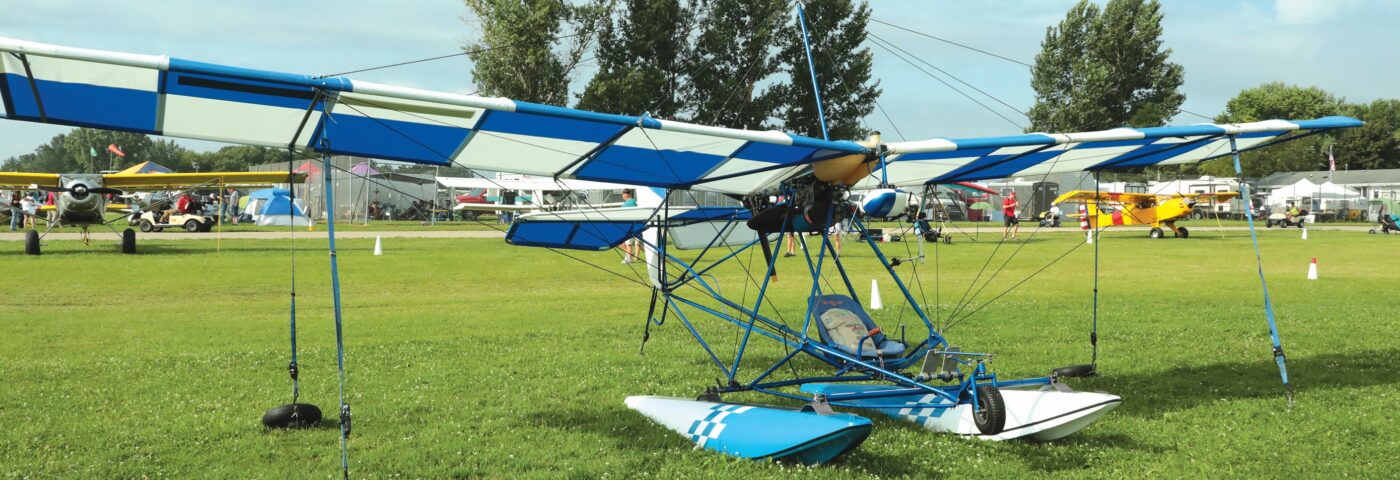
We trailered Bluey, my Quicksilver MX, to EAA AirVenture Oshkosh 2025 in hopes of assembling it and getting to fly in the Fun Fly Zone ultralight pattern. The ultralight field is only an active runway for the week of AirVenture. It is limited to arrivals only the week before and departures only on the last Sunday of the convention.
I wanted to get in as much practice as I could before the opening day, so I found a private airstrip about 15 miles west of Wittman Regional Airport where I could assemble Bluey and get in a couple hours of practice before flying in the Fun Fly Zone. The grass airstrip was smooth and right in the middle of a big cornfield. We camped there for a night, and I got in several nice landings and saw some beautiful Wisconsin countryside. (I thought we had a lot of lakes in Michigan, but I think the cheeseheads may have us beat in that category.)
Feeling more confident, we packed Bluey back into the trailer and returned to AirVenture the next day. It was reassembled with the help of fellow Michigan Ultralight Association (MULA) members Don Niles, EAA 1286117; Rob Edmunds, EAA 1451748; Mike Stanton; and Rick Hayes and tied down next to the EAA Ultralight & Light-Sport Aircraft Council (ULSAC) information tent next to the ultralight airstrip. The idea was to draw a little extra attention to the tent, and it seemed to work quite well. The booth was staffed by several MULA and ULSAC members throughout the week who answered questions from many, many visitors.
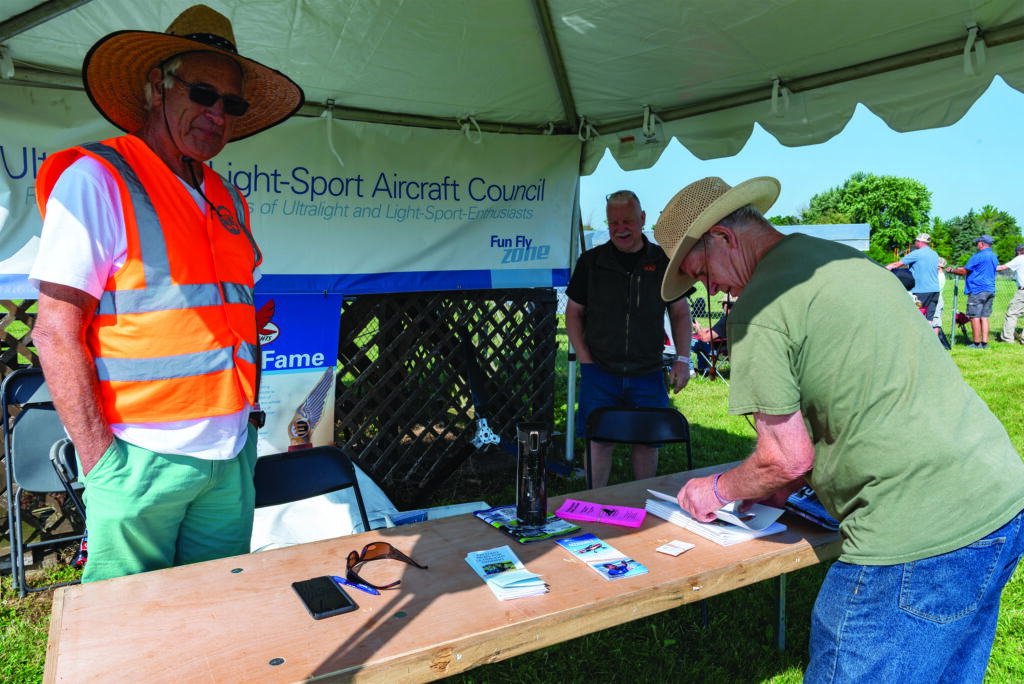
Flying in the Fun Fly Zone begins on opening day of AirVenture. The ultralight field is shared with powered parachutes and light rotorcraft, with each group getting a couple hours in the morning and evening to fly in the pattern. There are flight safety briefings each morning. If you wish to fly on any day, you must attend the briefing that day. I attended several of these briefings but couldn’t seem to work up the courage to actually fly.
The weather was not the best for such a low-time pilot as me, so I kept waiting for the perfect day. When flying the pattern, you must land on every round. Depending on wind direction, you either approach from the southeast or the northwest. The southeast approach was rather intimidating to me. It involves coming in straight north at 300 feet AGL and making a descending, sharp 45-degree turn and setting down on an uphill runway about 800 feet long. The northwest approach looked much more appealing to this rookie.
Finally, on Saturday morning the winds were nearly calm, and they were using the northwest approach. I was out of excuses for not flying. It was now or never. I attended my safety briefing and walked out to my airplane, untied it, and pushed it through the gate and onto the ultralight runway. I turned on the ignition switch, choked the carb, yelled “CLEAR PROP,” and pulled the starter cord of my trusty Quicksilver.
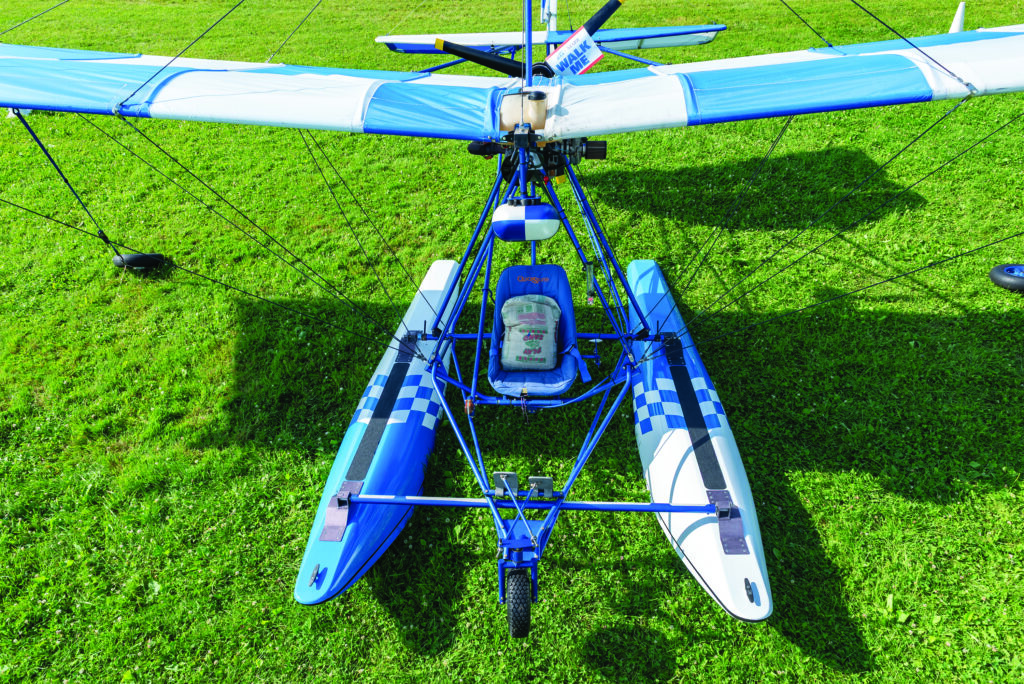
Then I pulled it again … and again … and again. Nothing.
As the crowd looked on, I pondered my situation. After a moment or two, I decided to turn on the fuel valve on the gas tank. One more pull and the mighty Rotax 447 engine roared to life — much to the approval of the many onlookers who all applauded my mechanical genius.
I strapped myself into the seat and taxied down to the south end of the field where all fueling is done. The guys there are incredibly helpful and got my tank filled in just a minute or two. I then taxied back north in front of the crowd.
I could hear the announcer talking about me and my flying machine. As luck would have it, the announcer that morning was my next-door camping neighbor. Thanks for the big buildup, Sean!
I took my place in line behind Mike Ostrander, EAA Lifetime 265473, in his MX getting ready to take off. Janie, my wife, and several friends, including EAA’s Ultralight and Lightplane Community Manager Timm Bogenhagen, were standing right there on the other side of the fence cheering me on. The air boss flagged Mike to the line and gave him the green paddle to take off. This would be takeoff number 810 for Mike and his 40-plus-year-old Quicksilver at AirVenture over the last 31 years. Congrats, Mike.
The air boss then directed me to pull forward and hold short while Mike climbed out and turned south at the end of the runway. A few seconds later, I was shown the green paddle to line up on the runway and take off. I opened the throttle part way, pulled forward, turned left, and stopped at the line. No time for deep thoughts now, it’s take off or get out of the way.
I eased the throttle fully open and quickly gained speed. I am always amazed at how quickly 40 hp can propel this kite down the runway. As I passed 35 mph on my Hall airspeed indicator (earlier in the week someone asked why I had a rain gauge on my airplane), I pulled back on the stick and was airborne, flying solo for the first time at AirVenture 2025, the greatest spectacle in aviation!
I climbed fast, easily rising above the surrounding trees before reaching the southeast end of the runway where I made a gentle turn to the south and climbed to the required pattern altitude of 300 feet AGL. I was excited but not really nervous. So far, this was pretty much like every flight I’d made at home or at MULA’s homebase at the Alkay Airport (51G), although I was super focused on my altitude and kept an eye on Mike about half a mile ahead of me.
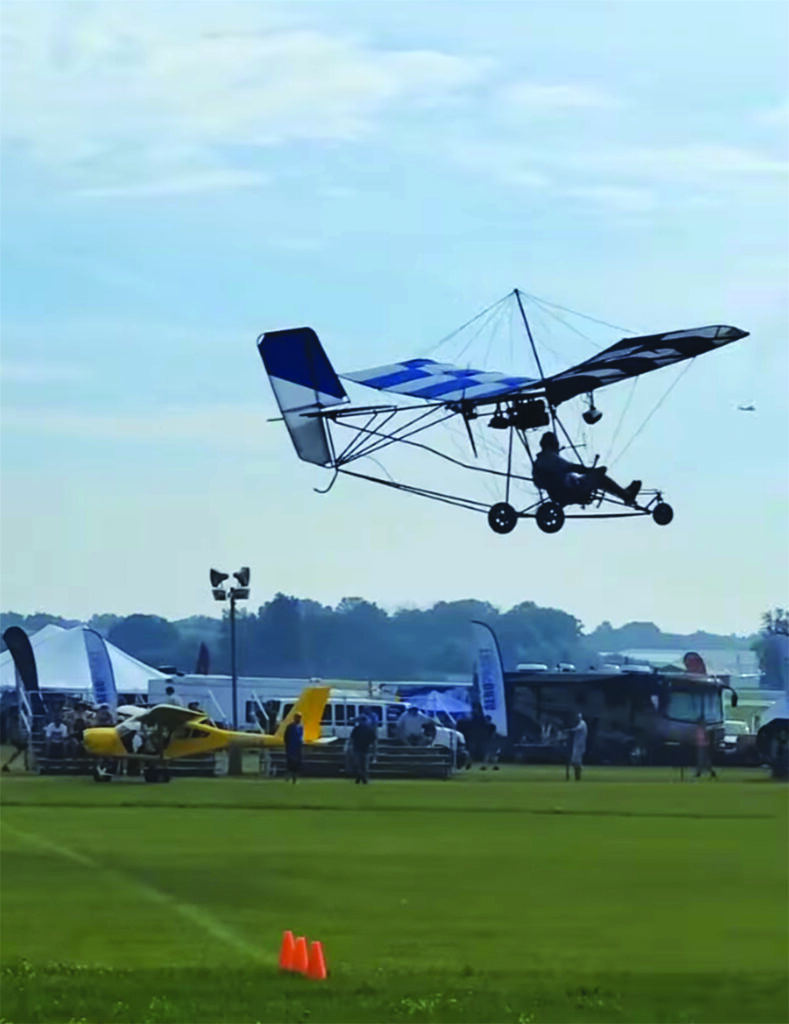
I made two more 45-degree turns until I was over Ripple Road and headed straight west. I made the next turn when I reached the interstate, and flew straight north just right of the service road. A minute or so later, I was turning right once again, flying directly over the emergency clear zone in Camp Scholler.
I eased the throttle back to about 4000 rpm and began a slow descent toward the northwest end of the ultralight runway and made a gentle 45-degree turn to line up with it. I came over the trees much higher than many of my fellow pilots, but Bluey comes down quickly with the throttle near idle. I was maybe a third of the way down the runway and a couple feet above it when I bumped the throttle just a bit to delay my touching down just a second or two, and then I pulled back gently as the rear wheels made firm contact with the ground, followed a few seconds later by the nose wheel.
Not the best landing I had ever made, but it was respectable. I coasted a few yards and turned left to get off the runway and rejoin the other airplanes getting ready to go again. Everyone was still right where I’d left them, and all were cheering me on. I’d done it!I had flown at AirVenture, the world’s biggest air show!
No sooner than I had gotten in line, I was being directed to pass several airplanes on the ground and take position behind Bever Borne, EAA 155256, and his Quicksilver Sprint. Directly ahead of Bever was Mike Ostrander again. I would be flying behind two legends in the Quicksilver world as the three of us, flying at about 35 mph, held up all the other airplanes waiting to circle the pattern.
They kept us together for a couple more rounds, and on my fourth trip around the patch, I finally relaxed my grip on the stick, breathed in deep, and started really looking around for the first time since my initial takeoff. Up until then, I had been completely focused on the task at hand. Now I was taking it all in and seeing AirVenture as I never had before, and it was magnificent! I could see everything. I could see Doc, the World War II B-29, in the big square alongside other aviation leviathans. I could see the endless rows of Van’s RVs parked wingtip to wingtip in the campground. I could see the gorgeous vintage Beech Staggerwings and Stinson Reliants glistening in the sun. I could see what had to be at least 40,000 campers spread out over the zillion or so acres of Camp Scholler.
There were tears in my eyes as I landed for the fourth and final time that Saturday morning. I shut off the ignition and fuel valve, climbed out of my trusty Bluey, gave it a little pat, and pushed it off the field. Janie gave me a big hug once I crossed the flag gate and asked me, “How was it?” All I could say was, “Incredible. It was just incredible.”
That’s it, friends. My first Oshkosh solo was over maybe a half-hour after it began. There are several things I hope I can remember until I take my last breath: my wedding day, the births of my two children, my first solo trip driving a semitruck to Chicago, and my father telling me how proud of me he was when I moved out of his house and into my first apartment. Then, my first solo in the MULA club’s Quicksilver MXL Sport at Alkay Airport after 10.6 hours of flight instruction from the best instructor in the world, John Von Linsowe. And now my first flight at AirVenture.
I wish Dad could have seen it — and maybe he did.
Happy skies, my friends!
Bill Darnell, EAA 576650, is the current secretary of the Michigan Ultralight Association Flying Club. He started flying ultralights two years ago at the age of 59 and is based at Calkins Field Airport (41C) in Wayland, Michigan.